
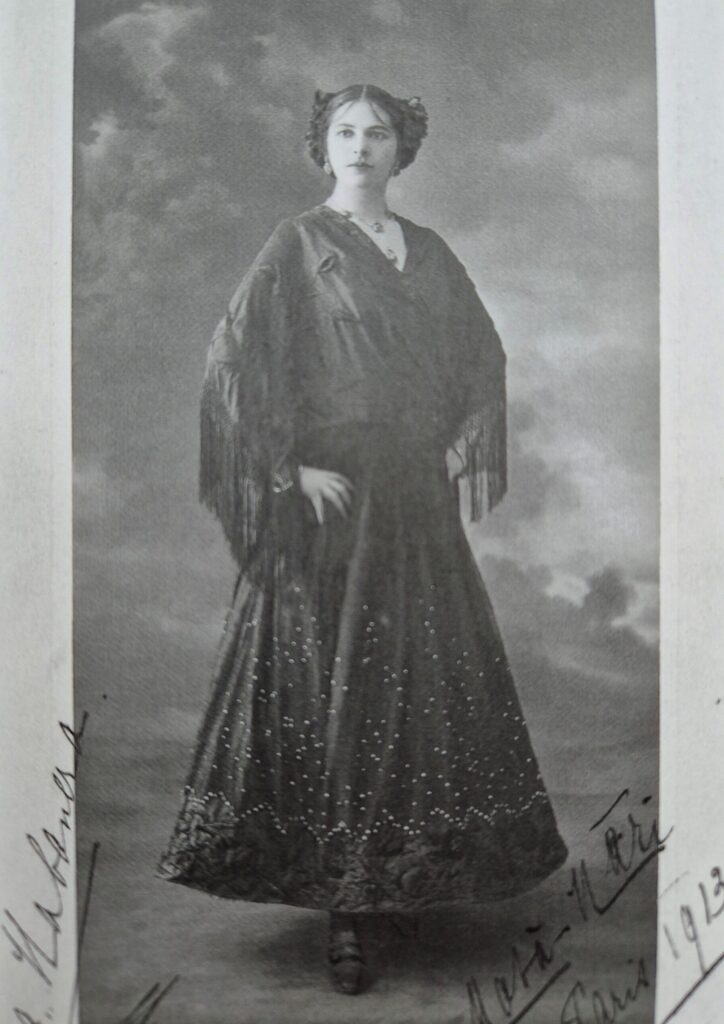
Mata Hari
Mata, “eye”, and hari, “day” were among the first words in my Indonesian vocabulary. And there is the combination of the two, “mata hari” for “sun”. I always liked the sound of this compound noun – three dark vowels followed by a light [i]..
The root forms for “sun”, in Austronesian languages from Taiwan to Sumatra, are ari or wagi. They originally had a double meaning of “day” and “sun”. In some languages, including Malay and Indonesian, the “eye” was added as a signifier for “sun”. My source here is, once again, the linguist Renward Brandstetter who wrote a short monograph about terms relating to nature in 1908.
Yet, in our European historical and cultural lexicon, Mata Hari resonates as the stage name for the Dutch-born dancer Margaretha Zelle (1877−1917).
On a recent visit to the province of Frisia, in its capital city Leeuwarden, I stepped into the “Fries Museum” – currently hosting an excellent exhibition on Redbad, legendary Frisian king of the 8th century – but was evenly fascinated by a room dedicated to “Mata Hari” – born in Leeuwarden in 1876.
At the risk of repeating a story only too well known to you, I was wondering: How did Margaretha Zelle become Mata Hari? The answer to that question has three elements: the Dutch East Indies, an evasion to Paris, and a French collector of Asian art, Emile Guimet.
The Dutch East Indies first: in 1895, Margaretha Zelle married a Dutch colonial army officer, Rudolf Mac Leod. She had answered on his advertisement in a newspaper and became Lady MacLeod. They went off to Malang in East Java, where he was first posted. She gave birth to two children, and certainly had some exposure to Javanese culture, including its dance traditions.
He was an alcoholic, and physically abused her. On returning to Europe in 1902, the couple separated and the marriage ended in divorce (1906).
Lady Mac Leod moved to Paris in 1903, broke and without the daughter (the son had died very young), where she built a career as a dancer and courtesan. Among the men who frequented her was Emile Guimet, Industrialist, collector of Asian art and founder of a museum – the Musée Guimet on Place d’Iéna – famous to this day for its Khmer art. Guimet provided her with a platform to perform a “sacred dance” to an élite audience – in his Museum’s library.
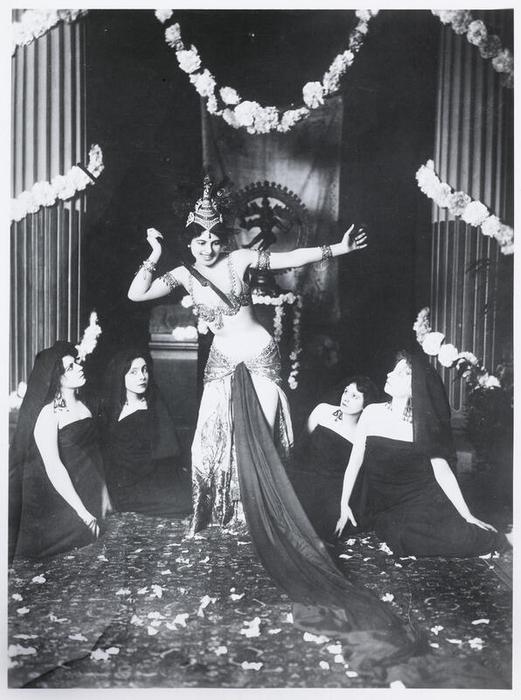
In March 1905, before the performance, Guimet asked “Lady MacLeod” to adopt a name that would fit her job description as a “temple dancer” from Java. She chose Mata Hari.
Both, the name and the dance propelled her to fame. “Tout Paris” was fascinated, the press mostly bought into the story (with the exception of “Le Rire”, a satirical journal). The public was hungry for this orientalist dream with an erotic touch, and the deceit and fictitious biography of “Mata Hari” was only consequential.After this episode, for a couple of years, Margaretha was adored, and in high demand as a dancer. Large amounts of money came in.
Her later biography is the stuff of fiction, film and detailed historical analysis. She seduced, got used by high-ranking men of France, Germany and other European countries. She got entangled in a web of alleged and real information trading. Accused of spying for the Germans the French government arrested, tried and executed her in 1917.
For this commentary, I have used:
Asaro, Gabriella, « Exotisme et érotisme à la Belle Époque : Mata-Hari au Musée Guimet », Histoire par l’image [en ligne], consulté le 07/10/2026. URL : http://histoire-image.org/etudes/exotisme-erotisme-belle-epoque-mata-hari-musee-guimet
Renward Brandstetter, 1908, “Mata-Hari oder Wanderungen eines indonesischen Sprachforschers durch die drei Reiche der Natur”, Luzern.