
There are many studies and monitoring efforts, both on national and international levels, on the state of agricultural biodiversity. The conclusions are usually not very uplifting, because they reaffirm its continuing decline in our agricultural areas – thus for example in the most comprehensive recent assessment provided by FAO’s “State of the world’s biodiversity for food and agriculture” (2019).
For once, I would share an observation that is representative of farmers’ efforts to maintain the diversity and, as it happens, the beauty of our fields.
In my neighborhood which is not far from the city center of Berne, the Swiss capital, there is some peri-urban agriculture, and it persists on this particular area as a result of the local population mobilizing against its development for urban housing. The scheme dated back to the 1960s and would have provided housing for up to 6’000 inhabitants. It was never shelved until the local referendum got a majority of votes in 1992. The area was kept in the agricultural zone, and under continuous cultivation.
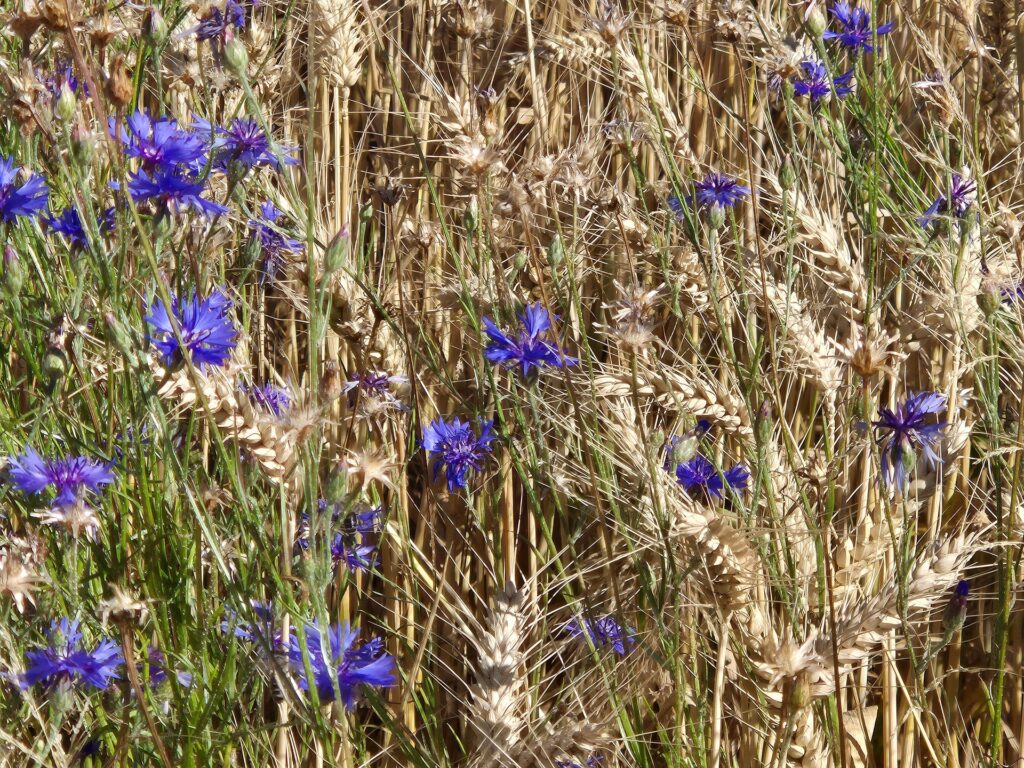
Thus, I pass there on a walk and see cornflowers, which I hadn’t seen for a long time – cornflower! Centaurea cyanus, with its typical flowers, grew as a „weed“ in European wheat fields for centuries, but has mostly disappeared in intensive agriculture over the last decades. Here it made its appearance, amidst the wheat, with beautiful flowers in stark blue (hence „cyanus“).
Beyond the aesthetic, this is also good news for insects and birds.