
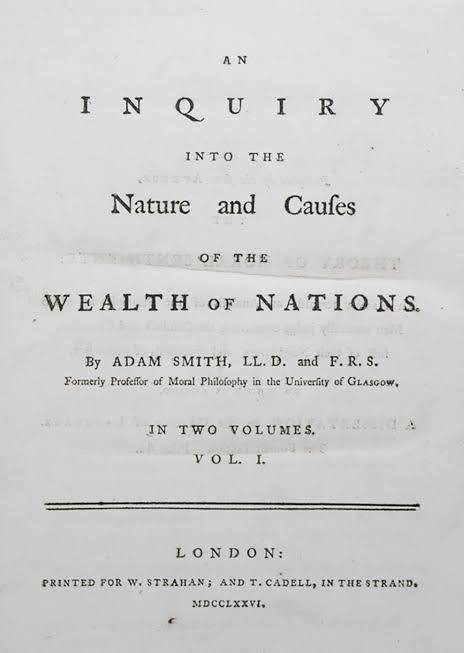
…on March 9, 1776, “An Inquiry into the nature and cause of the Wealth of Nations” by Adam Smith was published. The first edition printed in London in 500 or 750 copies has become a cult and collector object selling for up to USD 200’000. Never mind – the book remains a key text of political economy and is a fascinating read.
As could be expected, the anniversary prompted some opinion pieces reflecting on the relevance of “Wealth of Nations”.
Jason Furman in the New York Times highlights the fundamental optimism of Smith’s economic philosophy. Smith was “distrustful of structures that keep individuals from freely pursuing their own interests” in the economic sphere – and he showed “how ordinary people, pursuing ordinary lives, could steadily make societies richer, fairer and freer – if powerful institutions like governments, guilds or large businesses got out of their way”.
This is why, according to Furman, the “Wealth of Nations” presents “some of the clearest guidance for this moment” – one of its main intentions was to widen the circle of economic actors participating in the economy, based on their respective self-interest. That is indeed relevant, and Furman tries to position Smith in some kind of middle ground, unconvinced of the partisan readings by “laissez-faire” conservatives on the one hand and liberals or the left, worried about “anti-social greed” propelled by economic liberalism, on the other.
Sergio Aiolfi in the Neue Zürcher Zeitung also points to Smith’s intention – a policy objective in fact – to include a wider range of economic actors but he underlines the differences in historical context to today. Smith put two factors at the core of economic prosperity: advanced division of labor, leading to commodity surplus, and trade, both in tandem producing more wealth for the whole society. Yet Smith did not articulate a “theory of growth” fit for today’s economic challenges, and factors such as science, technology, innovation were not in his focus. The baker, the butcher and the brewer – the empirical stuff in Smith – were not exposing nor needing the constant search for innovation that characterizes today’s economic actors.
Furman grasps a current societal moment of anxiety facing de-industrialization, the rise of AI and, in general, innovation driven by large up-front capital investment. These „powerful structures“ would have worried Smith probably as much as did contemporary French absolutism with its focus on levying taxes, gold reserves, trade surpluses, and the exchange sphere in general.
Mercantilism informed much of economic thinking in France of that period when that nation’s economy was already in dire waters. Eventually, economic factors were a major factor contributing to the “Storming of the Bastille” on July 14, 1789. Read Eric Vuillard’s 2016 novel “14 Juillet” to get an idea how that was like!
References:
Aiolfi, Sergio. “Die Lehren des Metzgers, des Brauers und des Bäckers“. NZZ, March 9, 2021, p. 21.
Furman, Jason. “This Is the Moment Adam Smith Has Been Waiting For”. March 9, 2021.
Vuillard, Eric (2016). 14 Juillet. Arles: Actes Sud (German translation: Berlin, 2019)