
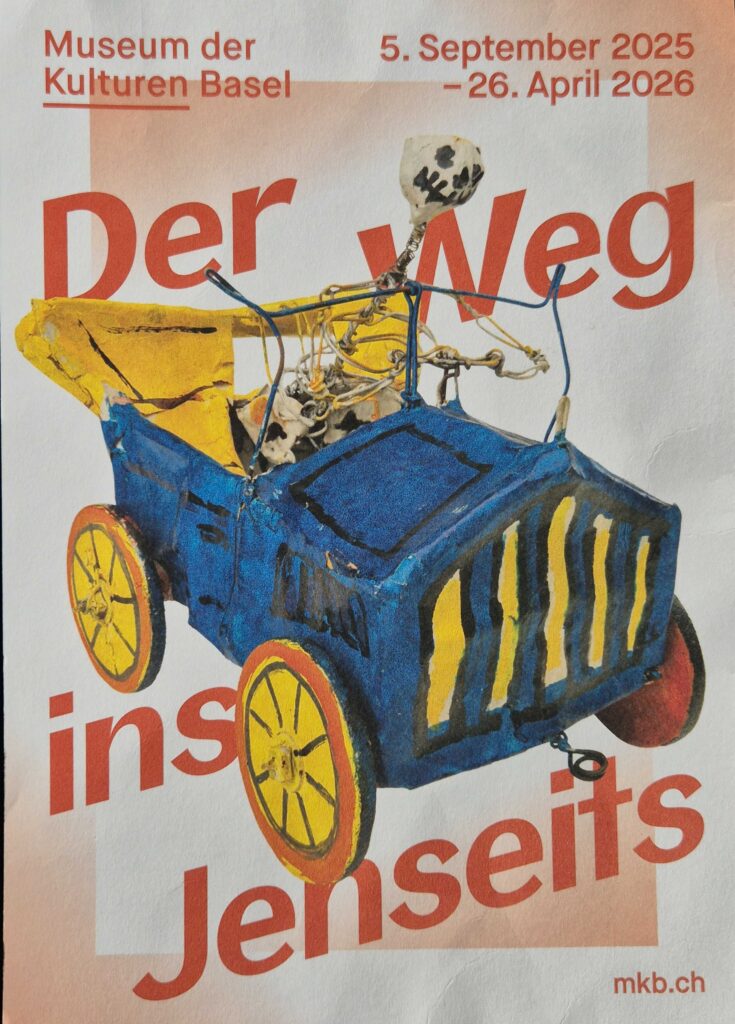
Last week, I went to Basel to visit the exhibition „Der Weg ins Jenseits“ (Path to the Beyond) at the Museum of Cultures in Basel. The picture shows object no. 42 „Death driving a jeep“ (Day of the Dead figure, Mexio 1960), from the exhibition poster.
The question of the Beyond, and the path leading us there after death may haunt us from time to time. We may have found answers in religion, philosophy or a personal belief system, or we may just be taking an agnostic view (“cannot know”).
How very differently societies, cultures and religions have imagined and defined their “Path to the Beyond”: this is the topic taken up in this exhibition (open until May 3, 2026 (slight extension).
“The Path to the Beyond”…
…has been curated by Richard Kunz, Head of the Southeast Asia Collections. He and his team have chosen to present 250 objects from the Museum’s rich collections, representing a range of cultures, religions and time periods, including our own culture and the present time. The ordering principle is not geographic, but rather what I would call “necessities of a journey”. There can be no summary of the thematic presentation here, but by way of introduction I will point at three objects which caught my attention.
The Hornbill Boat
[exhibit 85] – the hornbill is a bird of Southeast Asia related to the spiritual world by many cultures of the region, and also figuring prominently in Ngaju Dayak (Borneo) religion. The souls of their dead boarded a hornbill boat to reach the intermediate “village of the soul”, indeed an almost exact replica of a real village, but in the upper world. The souls stayed there for a few years until, down on earth, the rites for the second burial were performed by their relatives and the priests. Then, the soul would board a “soul boat” and make the transition to the village of Lewu Liau, the seventh layer of heaven, joining the community of the ancestors.
The Hell according to the Balinese
[exhibit 31] – Balinese mythology knows the descent into hell (and returning from there) – many kinds of torture await the sinful not unlike the Christian “inferno”. Thus, emphasis is placed on purification of the soul during and after cremation until it is so pure that it can join the ancestors in the family temple, and eventually be reborn. The time until second and final burial would last several years, in the Hindu-Balinese tradition as well.
Presence of Ancestors‘ souls
[exhibit 38] I like to contemplate the role of “ancestors” and their spirits in our cultures. It is mainly through their presence in material objects like statues, sculptures, tombstones etc. that we can remember. And there is this ambiguity between a remote, final resting place and proximity, perhaps at certain times of the year? In the Christian tradition, the night of November 1 opens a window to the souls – and to this day, adherents of the neopagan movement may prepare a meal for their ancestors visiting them that very night.
I recommend the visit. Once you go on your own through the exhibition (4th floor), I am certain you will find your own favorite objects. There is so much to see and reflect on.