
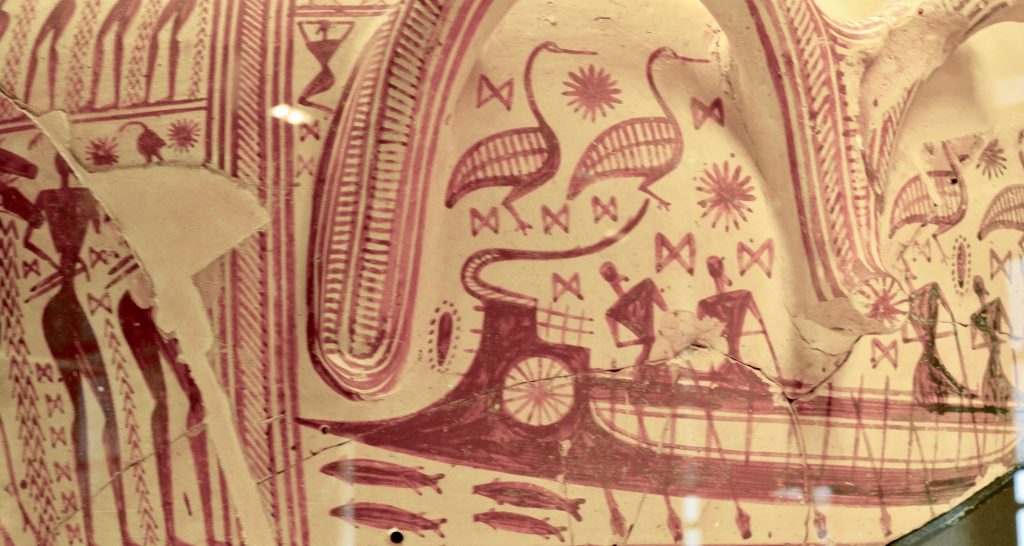
When the Greeks wanted to take the city of Troja, they sailed there with a big fleet of more than one thousand ships. The description of this armada takes many pages in Homer’s epic song on the war against Troja, the Ilias.
What purpose would such a description, written on a sheet of papyrus, serve on the chest of dead and mummified body in Roman Egypt? Last year, a papyri fragment was found in a tomb of Oxyrrhynchos – an ancient Egyptian town. It had been placed on the dead person. Scientist were able to decipher the fragment: it contained the description of the Greek fleet from the Ilias (reported in an article „Archäologen entdecken Verse aus Homers Ilias in einer Mumie“, May 7, 20026, Newspaper “Der Bund”).
It is clearly exceptional that a literary text (rather than verses from the book of death) was used to accompany the dead. The text is assumed to have been placed during the funerary rite on the body of the deceased person. Much remains subject to interpretation and speculation here, but what we can say is that ships appear frequently in representations of the transition to the world beyond, or the afterlife (as I also found when I visited the Basel exhibition on the “Path to the Beyond”, see my last commentary).
In addition, there is an interesting connection with oral epics here: many of these tales contain a theme of the hero traveling to and from the underworld. In some oral traditions, these stories were sung during the funeral rite.
How oral poetry works is a fascinating subject in itself. I recently finished reading a book by the American author Robert Karnigel who tells the story of Milman Parry, and his student Albert Lord („Hearing Homer’s Song”, New York, 2021). Based on fieldwork in Yugoslavia in the 1930s, these scholars documented the vanishing practice of performing oral poetry, and analyzed how it worked. If I say “vanishing”, I am also thinking of Indonesia, where I had myself the chance to listen to three of the last “singers of tales” in South Sumatra, during my fieldwork in 1988. I currently undertake some work to digitize the recordings of those performances.