
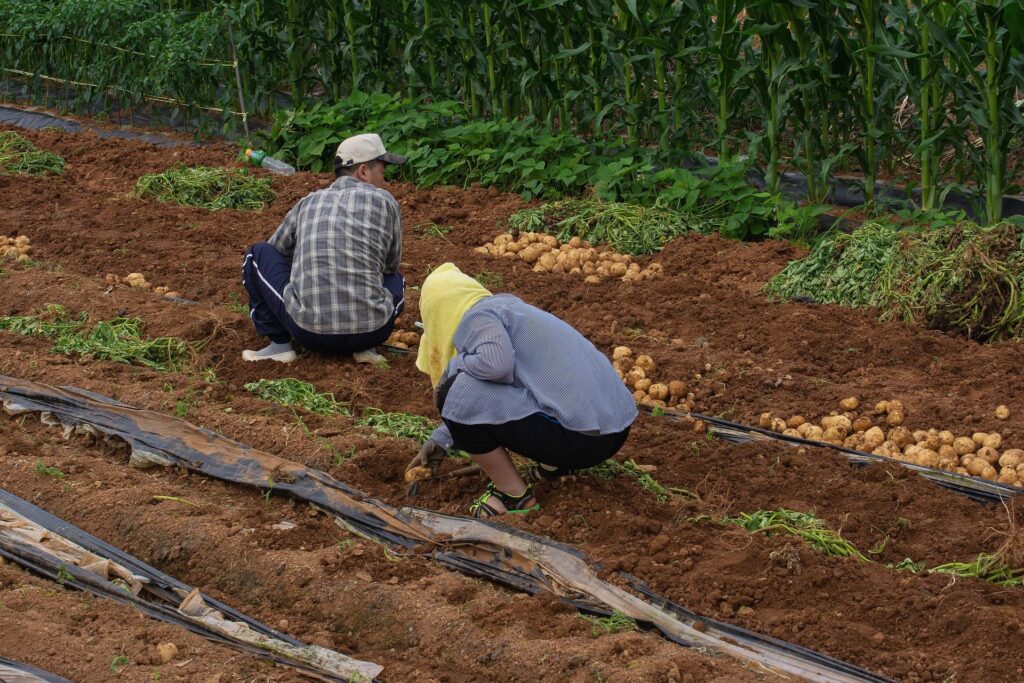
In Korea, the rural population has declined from 72% (1960) of the total population to just 17% (2010). In this development, a high yielding rice variety named „Tong-Il“ has played a prominent role in the 1970s, but more on this below.
„Maroo“, on the other hand, is a fictitious domestic potato variety which appears prominently in a K‑Drama series called the “Potato Lab”, which I recently watched.
The story is set in a national-style agricultural research institute and shows actual Korean potato breeding work – of special interest to me who has worked with plant breeders in a past function. We are also offered a glimpse into the rural dimension of life in modern Korea, as well as conveying a sense of the painstaking work of breeding potato varieties that are high-yielding and adapted to local conditions.
The series features Mi-Kyung, as the female protagonist. She is a passionate potato researcher who wants to develop a new variety that is as good or better than the established variety “Marshall”. In this process, she hits various bureaucratic and business-related obstacles. This mirrors the tension between Mi-Kyung and the male protagonist So Baek-Ho, who is in charge of organizational innovation at the big retail company Wonhan, and sent to the „Potato Lab“ on an efficiency mission.
There are other K‑dramas that build on the tension between the urban and the rural present. This should not surprise, as the urbanization of Korea is rather recent. In the 1950s, the country was an agrarian society, yet food production fell short of its needs. From 1954 to 1976 the US provided food aid, mainly in the form of wheat and barley. The average annual per capita income in 1961 was USD 72.
Between 1961 and 1979, the Republic of Korea was what can be called a “developmental dictatorship”: President Park Chung-Hee, a general, strong-handedly ruled the country aiming to put it on the path to industrialization and export-oriented economic growth.
Increasing food production was a priority target. The government drew up a seven-year plan (1964−1971) with measures targeting grain production, land reform, credit assistance for farmers, state price controls on the staple foods rice and barley, and subsidized minimum purchase prices for producers. To boost rice production, it launched “Tong-Il,” a new high-yielding variety.
But not just production were to change, but also the mindset of the rural population, so that it would gradually work its way up to a state of self-reliance and no longer depend on external assistance. In 1971, Park Chung-Hee launched Saemaul Undong, the “New Village Movement”. Saemaul Undong was both a material – cement for village roads and infrastructure was provided – and a spiritual approach – village gatherings that discussed self-help projects. It gave more space to grassroots initiatives than had previously been the case. Not least, the best villages were awarded prizes by the president himself.
For almost 20 years, the “movement” was active in rural areas. As a government program, it expired in 2000 and has since morphed into a knowledge center designed to promote Korean development experience around the globe. [1]
[1] OECD (2016). A new rural development paradigm. This study by the OECD’s Development Centre describes the Korean development case in chapter 5. Produced with the support of the Korean Ministry of Foreign Affairs, it tries to draw lessons from Korea and five other countries (Tanzania, Côte d’Ivoire, Vietnam, China, Thailand), in order to extract elements for a “new paradigm” for rural development.