
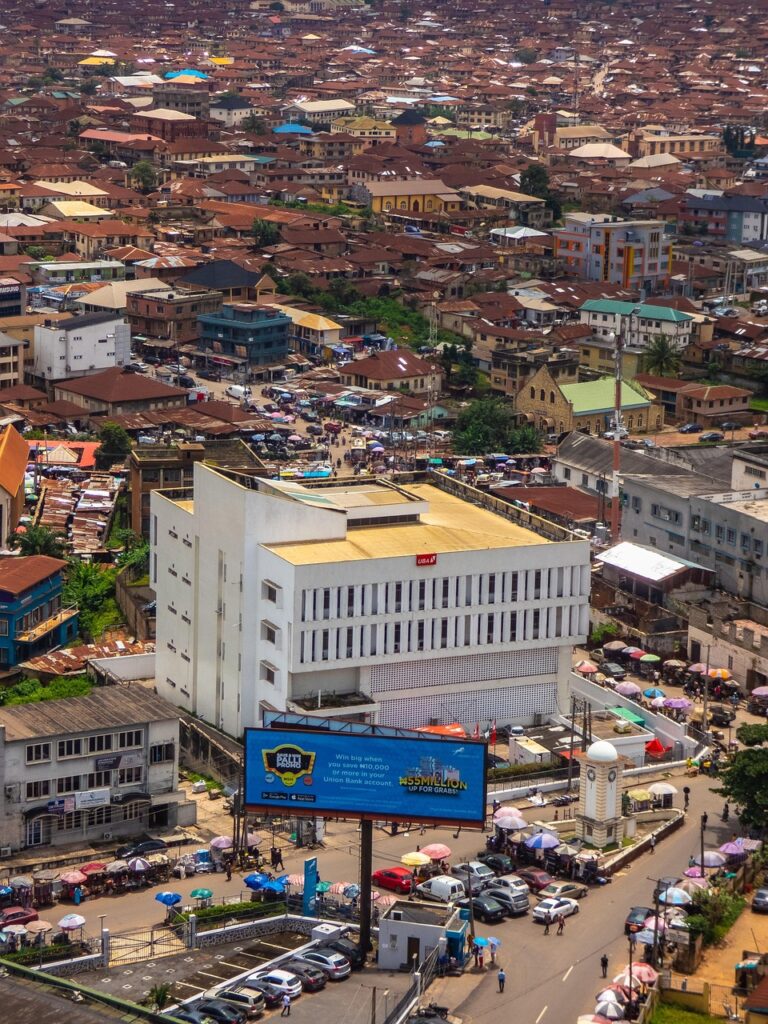
In our imagination, Africa may still be a continent with a dominantly rural population and vast untouched areas of forest and savanna. But the geographical space that is Africa will be more and more urban. Let’s look at some figures and projections, mostly taken from a study of the OECD published in 2017.[i]
Rapid growth and urbanization
Africa’s population is growing rapidly—so rapidly that by 2050, one in three young people (aged 15–29) will live in Africa. And by 2100, the African continent will be home to 40% of the world’s population.
At the same time, urbanization is progressing rapidly — well over a billion people (56%) will live in cities in 2050, compared to less than 500 million (41%) today. By 2030, Africa will have 95 cities with over a million inhabitants.
A closer look at West Africa
How this development plays out, will vary a lot in the different African regions. Geography and spatial interactions will be a key factor in the analysis of these urbanization processes. If we look at West Africa, for example, which has been the focus of the OECD study, the accelerating speed of urbanization is confirmed. In 1950, just 5 million people lived in cities[ii] in West Africa. By 2010, this figure had risen to 133 million, spread across 1,939 cities. Of these, more than a quarter (566) were established between 2001 and 2010.
Thus, we look at a future of a West African megalopolis with several hundred million inhabitants along a 2,000-kilometer corridor between Abidjan in the west, Lagos in the middle, and Douala in the east.
Urbanization – a boon or a burden?
This is an enormous challenge. Can states and municipalities keep up, at least to some extent, with the needs for planning, infrastructure development and its financing? And what will be the impact on the demography itself? Some demographers consider urbanization as an important factor in demographic transition, that is the transition to lower fertility rates: access to education, economic opportunities, smaller families.
However, average incomes in African cities remain very low, and endogenous population growth is high. Therefore, there is another view that Africa is urbanizing while remaining poor (this was the finding of the World Bank in a report published in 2017). We don’t know – both realities are likely, depending in region, location and economic resources, and constrained by a general lack of resources for truly sustainable urban development.
[i] Prieto Curiel, R., P. Heinrigs and l. Heo (2017), „Cities and Spatial Interactions in West Africa“. West African Papers no. 5, OECD Publishing. Paris
[ii] “City” is defined as “urban agglomerations” with more than 10,000 inhabitants and a certain density. The study is based on a data set of 2’000 cities in West Africa.